
You may hear that fish will not bite in the middle of the day. That is misleading: official beginner guidance says you can catch fish at any time of day. Dawn and dusk often help, but during daylight, try shade, shelter or deeper water. The right place depends on the fish.
Why am I not catching any fish?
Why am I not catching any fish? Your bait may not be reaching feeding fish, your rig may not work, or you may miss bites. Learn to Fish: Fishing Basics, our Android app, shows what to check when nothing bites. Check bait and depth first, then location, presentation and bite signals, changing one thing at a time.

Why am I not catching any fish? Check in this order
Start by separating three problems: no bites, bites without a hooked fish, and fish that come off after you hook them. Each needs a different fix.
For no bites, retrieve your rig, meaning the hook, weights and any bobber (float) on your line. Check it before changing locations or buying another lure.
| What you see | Possible cause | What to try |
|---|---|---|
| Hook comes back bare | Bait came off or was taken | Rebait securely and watch closely |
| Slim float lies flat as soon as it settles | Bottom contact or too little weight | Check depth and float weighting |
| Hook returns covered in weeds | Bait is hidden in plants | Fish above or beside them |
| Rig works, but nothing bites | Wrong depth or feeding area | Test depth, then another spot |
| Spinner blade does not turn | Weed or unsuitable retrieve speed | Clear it and check its movement |
| Bites happen, but no hookup | Slack line or wrong response | Check line contact and hook type |
Work through the relevant checks below. Treat each row as a clue, not proof.
Check that your bait and float are working
A baited hook can spend plenty of time in the water without fishing effectively. Retrieve it and look at what actually came back.
Check that bait remains attached and the hook is clear of weeds. Choose a bait and hook size suited to the fish you are trying to catch. A bulky bait on a large hook may be unsuitable for small fish. Ask locally about a permitted bait those fish eat.
Use the smallest float you can easily see that supports the bait without sinking. Too much float resistance can make a fish drop the bait. If a slim float made to stand upright lies flat as soon as it settles, the hook or weight may be on the bottom, or the float needs a little more weight. This check does not apply to a round bobber, which never stands upright. If an upright float suddenly tips over or rises while you wait, treat it as a possible bite.
For a fixed float, moving it farther from the hook makes the bait hang deeper; moving it closer makes the bait hang shallower. Fish may feed above the bottom, so test different bait depths.
Learn to Fish: Fishing Basics, our Android app, shows how to check a lake float rig and its depth. When nothing bites, it teaches you to check the bait, keep your spot and test one depth change before judging the result.
Find out where fish can feed today
A working rig still needs to reach fish, and their feeding places can change with the time of day and season.

Before your next trip, choose a locally common fish and read your local fishing authority's species advice or recent fishing reports. Ask which accessible shore areas hold that fish now. A lake containing fish does not tell you which part or depth to try.
Look for places that offer shelter and food: edges of water plants, shade, fallen branches or a change from shallow to deeper water. Cast beside cover, meaning objects or plants fish use for shelter, without burying the hook in it. On sheltered salt water, pier supports and the edges of underwater plants can also hold fish and their food.
In hot weather some fish move deeper, but that does not always mean the very bottom. Where warm surface water and cold deep water stop mixing in summer, oxygen below that boundary can become too low for fish to stay. Check local seasonal advice before choosing a depth.
Test another depth before repeatedly casting to the same empty patch. If there is still no response, try another reachable feature from safe, legal ground. You do not need to reach the farthest water you can see.
Compare another time of day on a later trip. Early morning or evening can be useful, but neither guarantees a catch. Choose a time when you can see your footing and return safely.
Adjust for river current and the tide at sea
Moving water changes both where food travels and how your bait reaches fish. Check the drift or bottom contact before treating a quiet session as a bait problem.

In a river, watch one drift
Look from the bank for sheltered water downstream of a rock or other obstruction. Let your float travel through one strip of water under control. If it repeatedly stops or sinks at the same point, check whether the hook or weights are catching the bottom.
When nothing bites, the app's river lessons teach you to check the drift and depth first. They then have you move the float about 1 foot (30 cm) higher on the line, making the bait run deeper, and repeat the same strip of water before choosing another safe spot. Skip that deeper test if you are already snagging.
At sea, check water movement and your exit
With a bottom rig, confirm that the weight reaches the bottom. Wind in loose line until you have light contact without dragging the rig. Around piers and jetties, fish may shelter on the side away from the current and intercept food passing by. Ask locally which tide to try for your chosen fish.
Stay out of the water and off wave-washed rocks: rip currents flow away from shore and can be hard to see, including beside piers and jetties. Before moving, check conditions and your return route with the first-time fishing guide.
Fishing and life jacket rules differ by country and region; check your local fishing authority. Saltwater licenses and rules can differ from freshwater ones.
Check how your lure or fly moves
An artificial bait needs to reach the fish at a suitable depth and move in a way they will take. Check those things before swapping colors.
Why am I not catching fish with lures?
First, inspect the lure for weeds or tangled line. From stable ground, draw it through water where you can see its movement, keeping hooks away from people.
An in-line spinner has a small metal blade that spins around a wire. Wind it in at an even pace, and if the blade stops spinning, speed up a little. A spoon is shaped to wobble or flutter. Learn what your chosen lure does before adding lots of rod movements.
Then test depth. For a sinking lure, allowing more time to sink can reach deeper water, while retrieve speed also changes its path. Keep the same lure and casting area while testing one change. If every cast collects weeds or snags, shorten the sinking time or try beside the obstruction.
Choose a lure size and shape that resembles food local fish eat. There is no single retrieve speed or color that suits every species and condition.
Why are fish ignoring my dry fly?
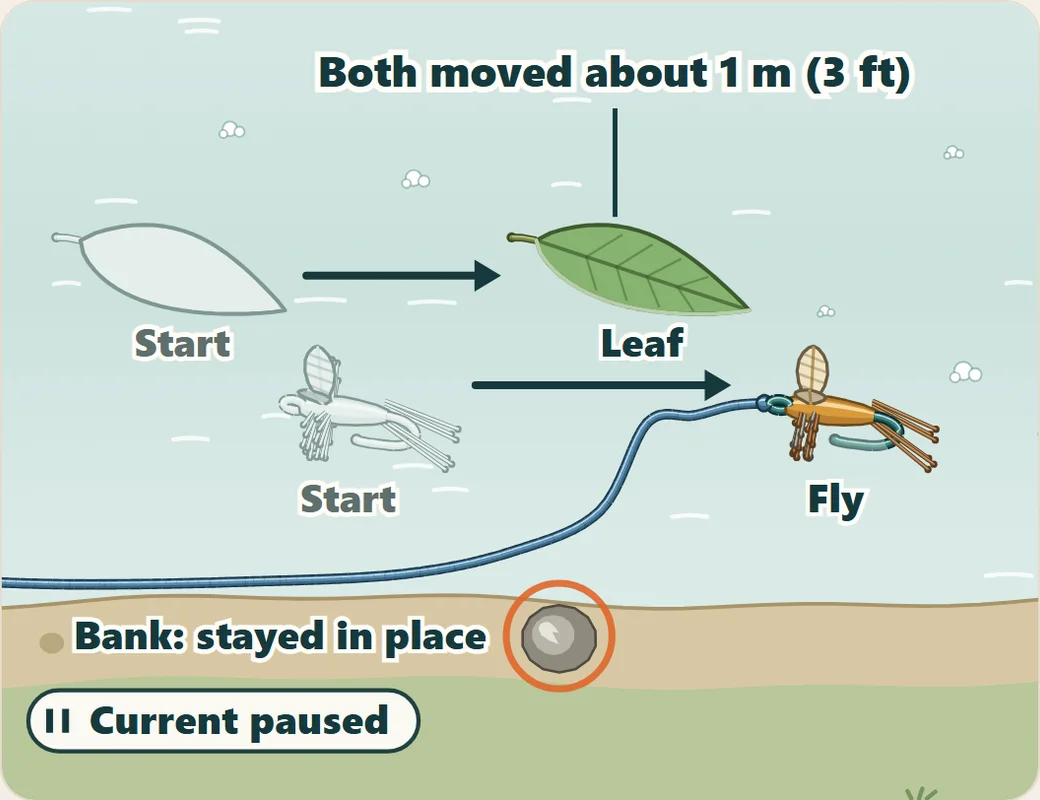
A dry fly is intended to float on the surface. Compare it with nearby bubbles or floating debris. If it skates across the current while they drift downstream, your line may be pulling it unnaturally. That is called drag.
Mending means repositioning the line on the water to reduce that pull without dragging the fly. The app's fly lessons teach this check, then drying or replacing a sinking dry fly. They also suggest changing one thing, such as fly size or color, checking the thin line end called the tippet, or resting the spot.
Approach without alarming fish
Your position and movement can matter even when the rig works and you have chosen suitable water. Check these before assuming you need different bait.
Fish can detect vibrations, and a shadow passing over the water can make them flee. Approach the edge slowly. Avoid heavy footsteps, banging equipment against a pier or dropping a tackle box. Where possible, keep your shadow off the patch you plan to fish. Do this from secure ground without leaning over an edge or climbing down rocks.
Keep casts controlled. If you have already disturbed a shallow spot, give it a rest or choose another safe patch rather than casting over it repeatedly.
Visible line can also put fish off. Line much heavier than needed can be more visible and reduce bites. Match its strength to the expected fish, your rod and reel, and nearby snags rather than choosing the thinnest line available. Ask for local guidance if you cannot judge that match.
Check whether you are missing bites
An empty hook or repeated float movements may mean fish have found your bait. Now check detection and your response rather than moving immediately.
Watch the float against the surrounding water. Waves usually move it with the surface; a fish can pull it under or move it differently. The app teaches this comparison and taking up the small slack in the line before responding. Keep watching while removing that loose line so you do not drag the float toward you.
With a bottom rig, watch both rod tip and line. A tug, moving line or sudden slack can signal a bite. Keep enough contact to notice changes.
If bait keeps vanishing without a clear signal, secure it more firmly and try a smaller piece. On a float rig, also try a smaller float and watch for smaller movements.
Respond according to the hook: a short, quick lift for an ordinary J-shaped hook, steady reeling for a circle hook, whose point curves inward. If fish still come off, is fishing hard to learn explains how slack, drag and hook type cause lost fish.
Change one thing at a time and keep notes
Pick one change, try it properly, and write down what happened. Changing bait, depth, lure and location together makes the result hard to interpret.
Avoid these no-bite mistakes:
- Changing after one poor cast. First make sure the bait reached the intended place and the rig worked. Repeat controlled casts or drifts before judging the setup.
- Repeating without checking. Waiting longer will not replace missing bait or clear a weed-covered hook. Retrieve and inspect it.
- Staying indefinitely without a reason. Once you have tested a working rig at another depth, consider a different safe feature or another time of day.
- Calling the whole trip a failure. Record what worked, what did not and one thing to try next.
There is no waiting time that guarantees a fair test everywhere. Give each setup enough repeatable attempts to observe it, while checking bait and conditions.
Write a short log: place, time, depth, bait or lure, conditions, bites and the change you tested. At sea, add the tide and what the line did. The app's sea lessons include recording trips with no fish and choosing one safe change for next time; its lake path ends with logging the trip and choosing what to practice next.
If you need someone to watch your setup, free learn-to-fish events may be available. For these and gear loans, can you teach yourself to fish explains where to look.
Frequently asked questions
Why can't I catch fish when everyone else is catching them?
Compare the exact place and depth their bait reaches, not just its color. Check your bait, hook size, line strength and lure movement. Ask politely what fish they are targeting and how deep they are fishing. Change one part of your setup so you can judge whether it helps.
Should I change lure color if nothing bites?
Check depth and movement first. Clear weeds from the lure and make sure it works as intended. Test retrieve speed or sinking time while keeping the same lure and area. Then, if you try a different color, keep the other conditions the same so you can compare the result.
How long should I wait before moving fishing spots?
There is no universal limit. Inspect your bait and rig first, then give one depth or presentation change several controlled attempts. Move when you have a reason to test another feature, not simply because one cast failed. Leave immediately if weather, waves or rising water threaten your position or exit.
Does a bigger float make bites easier to see?
Not necessarily. A larger float makes a fish feel more resistance when it takes the bait, so it may let go. Use the smallest float you can easily see that supports the bait without sinking. The float must be visible to you without being difficult for a fish to pull under.
Should I fish deeper if nothing is biting?
Test another depth, but deeper is not automatically better. Fish may feed above the bottom. If your hook returns with weeds or repeatedly snags, try shallower instead. With a fixed float, increase the distance between float and hook to fish deeper, or reduce it to fish shallower.
What tide should I try for sea fishing from shore?
Ask a local tackle shop or club which tide to try for your target fish, then record the tide stage on each trip. Around piers and jetties, moving water can carry food past fish sheltering behind structures. Check the tide table for your return route too, since rising water can cut off access.
Which conditions should I log on a trip with no bites?
Record where and when you fished, depth, bait or lure, weather, any bites and the one change you tried. At sea, add the tide; in a river, describe the drift. Include missing bait, weeds and snags. Those observations tell you more than a catch total alone.
Sources
- Ontario Ministry of Natural Resources: Learn to Fish guide
- New York State Department of Environmental Conservation: Basic fishing tackle and techniques
- New York State Department of Environmental Conservation: Intermediate fishing tackle and techniques
- Texas Parks and Wildlife Department: A Basic Guide for the Beginning Angler
- National Park Service: Fly fishing
- Surf Life Saving NSW: Rock fishing
- National Weather Service: Rip current science
- Fisheries and Oceans Canada: Learn about and apply for a recreational fishing licence
- Ontario Ministry of Natural Resources: Learn to Fish
- Texas Parks and Wildlife Department: Tackle Loaner Program
- Illinois Department of Natural Resources: Fishing: For anglers of all ages
- Iowa Department of Natural Resources: 6 Reasons You're Not Catching Fish
- Surf Life Saving NSW: Rip currents
- Wiley: Fishing For Dummies, 2nd edition, by Peter Kaminsky and Greg Schwipps (2011)
- Wiley: Fly Fishing For Dummies, 2nd edition, by Peter Kaminsky (2021)