Is fishing hard to learn? No. The basics are easy to learn step by step, for example with Learn to Fish: Fishing Basics, our Android app. Casting, untangled line and spotting bites take practice. Finding fish is harder, because where they feed keeps changing. Start from shore and fix one problem at a time.
One common belief is that you need a boat to catch fish. You do not. Most people start fishing from the shore of a lake, a river or the sea. Pick a spot with firm ground and room to cast, where small fish are common close to the edge.
Before fishing, check the rules with your local fishing authority, the government agency that manages fishing where you plan to fish.
Is fishing hard to learn at the start?
You have two things to learn: how to use your rod and reel, and where to put your bait. You can work on them separately.
Casting means sending your bait or lure out over the water with the rod. A lure is an artificial bait. You can practice casting accurately, keeping line free of tangles and responding to bites. Choosing a spot and deciding how deep to fish take experience. The depth where you find fish can change with the season.
Use these stages as a practice plan, rather than a timetable for when you should catch fish:
Stage
What you are working on
A useful sign of progress
First trip
Controlled casts, line free of tangles and watching for bites
You know whether casting, tangles or bites went wrong most
Next few trips
Fixing loops, adjusting depth and keeping fish hooked
You know what to check when something goes wrong
As seasons change
Finding fish when their usual locations change
You can explain why you chose a spot or depth
A bait-and-bobber rig gives you a manageable starting point. A rig is the hook, float and any weight attached to your line. The bobber shows when a fish takes the bait. Once you can use the rig reliably, compare different spots and bait depths.
Learn to Fish: Fishing Basics, our Android app, splits learning the same way. Three quick choices (where you want to fish, how, and your experience) set up a learning path that takes you through one step at a time.
Why does my spinning reel keep tangling?
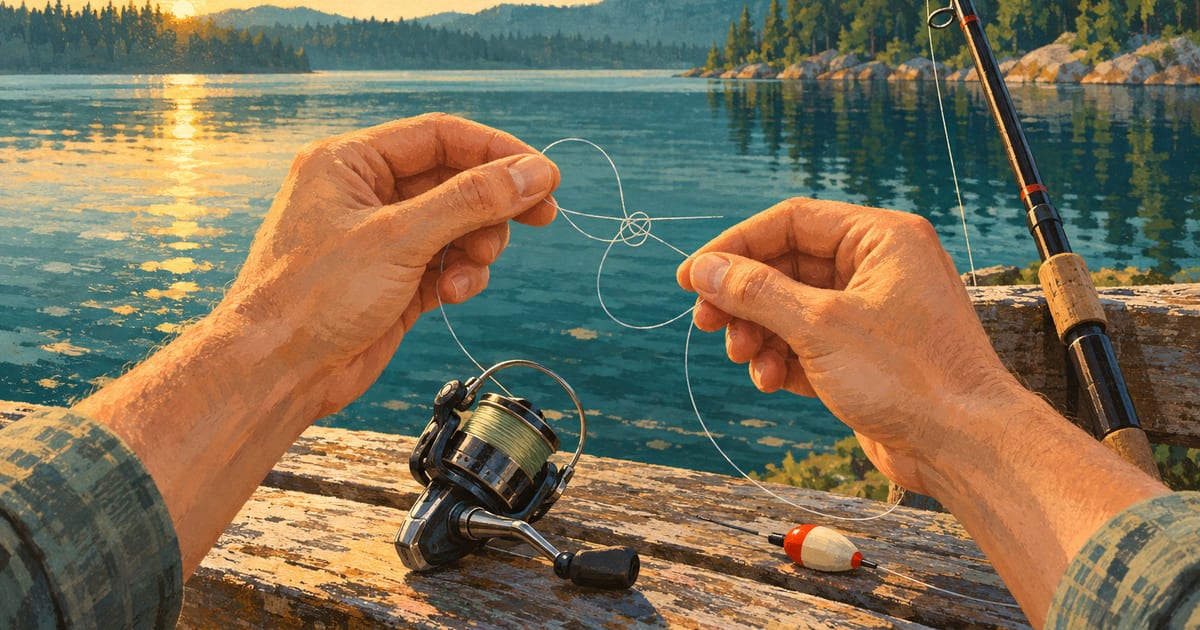
A spinning reel is the open reel that hangs under the rod. Most of its tangles start when line goes onto the spool (the part that holds the line) the wrong way or too loosely, which makes loops.
Check these things before your next cast:
Line put on wrong: follow the instructions on the line package when you put new line on the reel.
Too much line: leave about 1/8 inch (3 mm) between the line and the spool's edge as a starting point. Follow your reel's instructions if they specify a different gap.
Closing the bail with the handle: the bail is the curved metal arm that guides line onto the spool. After each cast, flip it closed by hand instead of turning the handle. Give the line just above the reel a light tug before winding.
Loose line going onto the spool: keep the line tight as you wind it back, so it goes onto the spool firmly.
Line that keeps twisting: replace it. Monofilament, a single strand of nylon, can retain the shape of the spool after long storage and curl into tangles.
A lure twisting the line: an in-line spinner has a revolving blade and can twist your line. A ball-bearing swivel, a small rotating metal connector, can help. A snap-swivel adds a clip for changing lures, but can stop some lures moving as intended. Use it with spinners, not with every lure.
If you already see a loop on the spool, stop before casting again. Open the bail and pull line off until the loop comes free. Then close the bail and keep the line tight as you wind it back. Trying to cast the loop out can make the tangle worse.
A push-button spincast reel avoids one particular tangle: backlash. This happens when a rotating spool spins faster than line leaves it. A spincast spool stays still during a cast, but line can still tangle inside its cover or around the rod tip. Baitcasting reels have rotating spools and need practice to prevent backlash.
What should I change when I get no bites?
If your bobber never moves, first check how deep your bait is and whether your bobber is too big.
After checking depth and bobber size, move along the shore toward weeds, rocks or shade.
For bait-and-bobber fishing in calm freshwater, try these checks in order:
Check the depth. As a first try, hang the bait 1 to 3 feet (30 to 90 cm) below the bobber. This depth comes from advice for one common small pond fish, so treat it as a starting point, not a rule. Adjust the float to try deeper or shallower water until you find bites.
Check the bobber. Use the smallest one you can see that supports the bait without sinking. An oversized float creates more resistance when a fish takes the bait, which can make it let go.
Try another reachable spot. Move along the shoreline instead of repeating the same cast indefinitely. Look for weed edges, rocks or shade.
Try another time of day. If you always fish at midday, try early morning or evening on another trip. Note whether you get more bites.
Change one thing at a time: depth first, for example, then the spot. Write down where you cast, how deep the bait was and whether you got bites. A bite after one change is a useful clue. For checks on rivers, at the sea, with lures and with a fly, see why am I not catching any fish.
The app gives the same advice when nothing bites on a lake: check that the float rig works and the bait is still on, keep your spot, try one depth change and note what happened.
Watch the weather. Check the forecast before you go. If you hear thunder, lightning is close enough to strike you. Leave the water at once and get inside a building with electricity or plumbing, or a car with a hard metal roof and the windows closed. Never shelter under a tree. Wait 30 minutes after the last thunder before you fish again.
Why do fish keep coming off the hook?
When fish take the bait but come off the hook, check loose line, the reel's drag and how you respond to bites.
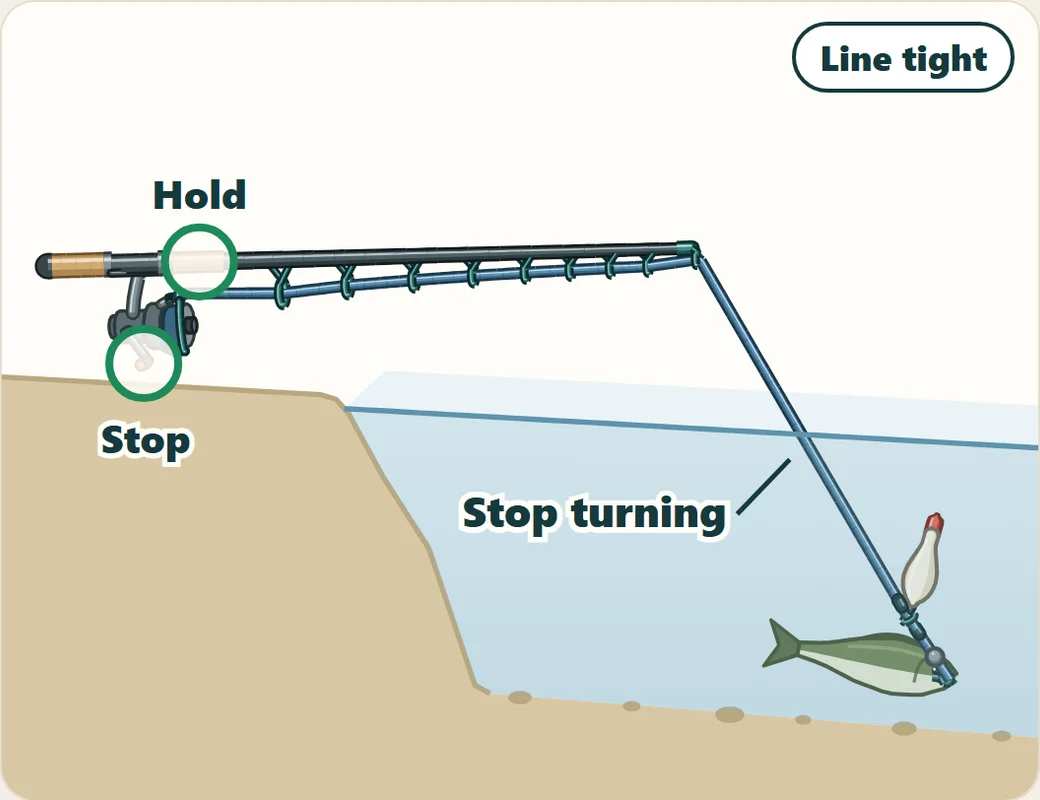
Remove excess slack after the cast. Slack is loose line between your rod and float. On a push-button spincast reel, turn the handle and wind in the excess loose line. With a spinning reel, close the bail by hand before winding. The app's bite lesson teaches the same first move: take up the small slack before you respond.
From the bite lesson: wind in only the loose line, and stop turning once it is tight.
Check drag before fishing. The drag is a knob or dial on the reel that sets how hard a fish must pull to take line out. Too tight, and the line can break; too loose, and you may fail to hook or control the fish. Set the reel as if a fish were on: close a spinning reel's bail, or turn a spincast reel's handle once. Pull the line (not the hook) by hand. It should slide out against firm resistance. If it slides too easily, tighten the drag (the direction is usually marked +). If it will not slide, loosen it.
Match your response to the hook. An ordinary J-hook has an open, J-shaped bend. When the bobber goes under, raise the rod quickly to drive the point into the fish's mouth. This is called setting the hook. A circle hook has a point that curves inward. With that hook, reel steadily until it takes hold instead of jerking the rod upward.
Keep pressure on a hooked fish. Do not let the line go loose. Let the drag release line when the fish pulls hard.
If you plan to let fish go, use a rod and line strong enough to bring them in quickly. Never let a fish fight until it is worn out.
Common beginner mistakes with snags, bait and hooks
Three other problems are common: hooks caught on the bottom, small fish stealing bait and fish that swallow the hook.
If you keep snagging: a snag is a hook caught on something other than a fish. Aim for the edges and openings in water plants, and watch for underwater branches and rocks. Fish use these places for shelter, but you do not have to cast into the thickest part. Accuracy is usually more useful than distance. Before each cast, check behind and around you for people, branches and other obstructions.
If small fish keep stealing your bait: check bait size and how you respond to bites. When using worms, try a piece just large enough to cover the hook instead of a whole large worm. With a J-hook, respond when the bobber goes under or moves along the surface. With a circle hook, reel steadily. For step-by-step baiting, see how to learn fishing from the start.
If a fish has swallowed the hook: do not tear it out. If you cannot remove it easily, cut the line as close to the hook as you can safely reach. Have line cutters ready before you fish. Handle a fish as little as possible, use wet hands and remove the hook while it is in the water whenever possible. Keep it out of the water for less than a minute.
Does the type of fishing make a difference?
Some methods give you more to learn at once. Fishing with bait from shore, casting lures and handling a boat each call for different skills.
Bait from shore, lures and boats each call for different skills, on any water.
Method
What adds difficulty
What keeps it manageable
Bait and bobber from shore
Choosing depth and recognizing bites
The bobber provides a visible signal
Lures on a spinning rod and reel
Making the lure move like live food, cast after cast
Start with one in-line spinner wound in at a steady speed
Baitcasting
Controlling a rotating spool to prevent backlash
Practice casting before you fish with it
Fishing from a boat
Boat handling, weather and navigation
Take a boating safety course
Fly fishing
A different cast that uses the line's weight
Set aside time to practice the cast
Fisheries guides recommend a push-button spincast reel for beginners. A spinning reel also works once you learn to use its bail. Start with one lure and learn how it moves through the water.
Baitcasting and fly fishing generally take more practice than using spincast or spinning gear. In fly fishing, the line's weight carries a light artificial fly through the cast. You need to learn a different casting movement and manage the loose fly line. You can still start there if that is the fishing you want to learn: the app has a separate fly-fishing path from a river shore.
A boat adds its own skills: handling it, judging weather and navigating safely. A boating safety course teaches these skills, and some places require one before you drive a motorboat. Wear an approved life jacket that fits properly. Life jacket rules and approval standards differ by country and region. Check the rules with your local fishing and boating authorities before you go.
What is the simplest way to make fishing easier?
Pick one problem to work on during your next trip. You do not have to fix everything at once.
Choose calm water where you may legally fish from the shore: a pond, a lake, a slow river or a sheltered sea spot such as a pier. Look for small, plentiful fish that feed near the edge and room to cast safely. Use one simple bait rig.
License requirements, seasons, permitted bait and limits on the size and number of fish you may keep differ by country and region. Check your local fishing authority's current rules for the water you plan to fish.
Then choose your focus:
If tangles ended the last trip, inspect the spool and practice closing the bail by hand before making another cast.
If the rig worked but nothing bit, compare bait depths, then try another spot along the shore.
If you hooked fish but lost them, check drag, loose line and whether your hook needs an upward pull or steady reeling.
A basic bait-and-bobber method is a manageable place to begin because the float shows when a fish takes the bait. Finding fish as locations and conditions change takes more experience. Start with one method and work on a particular problem, such as loose line or missed bites.
How long does it take to get good at fishing?
There is no fixed timetable. Use your first trip to practice casting and watching the float. On later trips, work through tangles, missed bites or other problems. As seasons change, compare where you find fish. These are practice goals, not a promise about how soon you will catch fish regularly.
Why does my fishing line tangle on every cast?
Check whether the line was put on wrong, wound on loosely, overfills the spool or keeps twisting. Close a spinning reel's bail by hand. A gap of about 1/8 inch (3 mm) below the spool edge is a starting point; check your reel's instructions. Remove visible loops before casting again, then wind the line back under light tension.
Why am I getting bites but catching nothing?
First check loose line and drag. With an ordinary J-hook, raise the rod quickly when the float goes under. With a circle hook, reel steadily instead. For small fish, also check bait size and use a float only large enough to support it. Too much float resistance can make a fish let go.
Is fishing mostly luck?
You cannot guarantee a catch, but you can change where you cast, how deep your bait hangs and how you respond to bites. Learning to adjust these things improves your decisions even when you cannot predict the next bite.
Is fly fishing too hard for a beginner?
It takes extra casting and line-control practice. The line's weight carries the cast, rather than the weight of bait or a lure. A beginner can choose fly fishing, but should expect to spend time learning that different casting movement. Start there if it is the fishing you want to practice.