You can start without paying for instruction. IGFA's free Intro to Fishing course welcomes beginners, including adults. Fishing authorities also publish beginner guides and online demonstrations. The useful question is whether the lessons fit where and how you want to fish, and give you something clear to practice.
Online fishing course: can you learn to fish online?
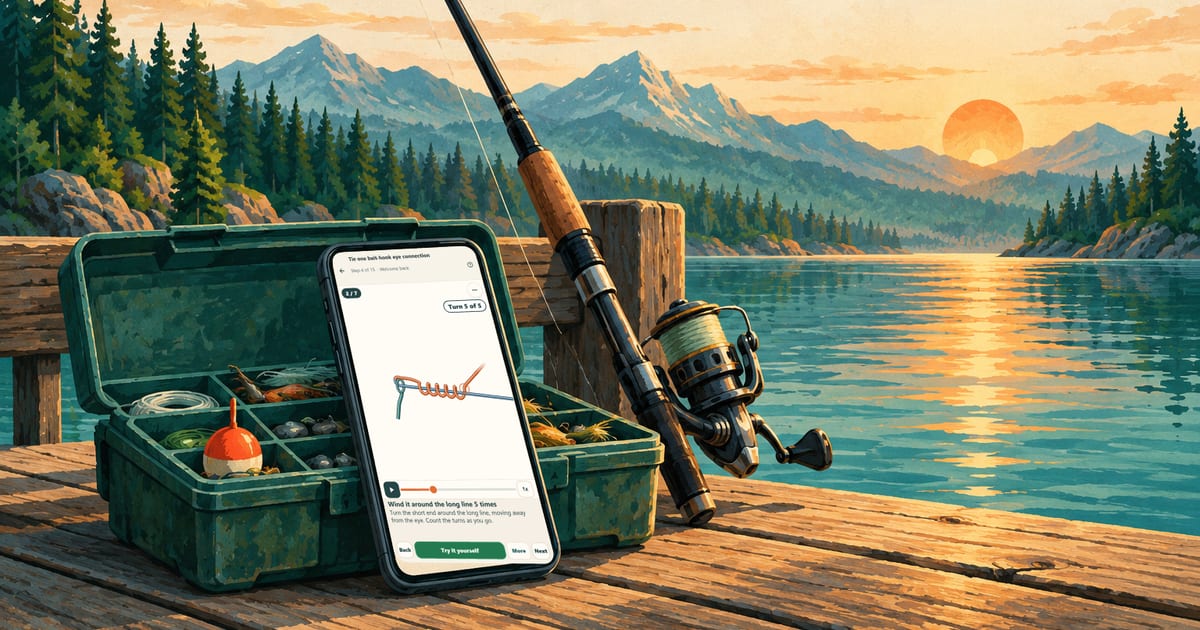
Yes, an online fishing course can teach you gear setup, knots, casting and careful fish handling. Learn to Fish: Fishing Basics, our Android app, guides those steps with hands-on practice. Use online lessons to prepare, then practice with your own equipment and learn to read real conditions beside the water.
Which kind of online fishing course fits you?
Choose a format that gives you clear instructions for the equipment and water you plan to use.
Online learning can mean a guide you read, a series of demonstrations, a course with review questions, or an app with guided practice. Use this table to decide what to inspect before starting:
| Format | Cost | Useful for | Check before choosing |
|---|---|---|---|
| Fishing authority guides and videos | Free | Local rules and basic skills | Does it cover your water and reel? |
| Free courses, such as IGFA's | Free | A broad beginner overview | Does it match how you will fish? |
| Paid video courses | Varies | Studying one method or skill | What gear and skills does it assume? |
| Interactive learning apps | Varies; check free lessons | Following a practice path | What can you use before paying? |
A beginner should be able to follow the rod setup before learning advanced techniques. A lesson about boat equipment will not answer every question about casting bait from a beach. Read the lesson list, even when a course says it is for beginners.
Learn to Fish: Fishing Basics, our Android app, uses three choices (where you want to fish, how, and your experience) to set up a learning path. Its lake path from the shore with bait starts with setting up and checking a spinning rod and reel, then builds toward casting, bites and careful fish handling.
Where can you find free fishing lessons online?
Start with a free beginner course whose lesson list you can read before you sign up.
IGFA's Intro to Fishing is a free online course, designed for young people and beginners, with adults welcome too. Its published lesson list includes:
- Freshwater and saltwater fish identification and habitats.
- Setting up spinning and push-button spincast equipment.
- Knots, natural bait, artificial bait and saltwater bait.
- Casting, safety, catching fish and catch-and-release practices.
There are review questions and a knot handout for practice. This makes it a useful broad introduction. You still need current rules for your own water and practice with your own equipment. A general course's fish-identification examples do not replace learning the species you might catch locally.
Your local fishing authority is another starting point for free online fishing courses, beginner guides and video demonstrations. Some official digital programs combine videos, quizzes and written guides. Others offer separate resources for casting, knots or fish care. A guide can be useful without calling itself a course.
Search the authority's website for "learn to fish," "beginner fishing videos" or "fishing guide." Check which water and reel the instructions cover.
For local learn-to-fish events, gear loan programs and license-free fishing days where available, see can you teach yourself to fish.
When are paid online fishing classes worth it?
Consider paying when you can name the skill you want help with and see how the course teaches it.
Before buying a fishing course online, preview a lesson. Try following its instructions with your own equipment. Can you see the line clearly? Does the instructor explain unfamiliar words? Do you know what to practice after watching?
For a complete beginner, check whether the course starts with assembling and using the equipment. Save instruction that assumes advanced gear or existing casting skills until you need it. A long lesson library can still leave a gap at the step you cannot do.
Ask these questions before entering payment details:
- Is this a one-time purchase or a recurring subscription?
- How long can I access the lessons?
- Can I replay, slow down or download demonstrations?
- Are questions answered by a person, or is the course self-paced only?
- What are the cancellation and refund terms?
The first 2 lessons of each path in the app are free, and a weekly or yearly subscription opens the rest. The subscription has no free trial, so use those 2 lessons to judge whether the teaching suits you.
Check the lesson order before you enroll
A useful beginner syllabus connects the small jobs you must do before and during fishing.
Look for an order you can follow with your hands, including preparing for a fish before you hook one. This is a practical way to compare courses:
| Part of the course | What it should show | What you should be asked to do |
|---|---|---|
| Rules and safety | Where to check rules and assess hazards | Check your planned water |
| Equipment and setup | Reel controls, line, a knot and a rig | Prepare the demonstrated setup |
| Casting | Safe space and a hookless demonstration | Practice controlled casts |
| Bites and landing | What to watch and how to bring fish in | Prepare the landing tools |
| Fish care | Unhooking and careful release | Learn the steps before fishing |
A rig is the hook, weights and any float arranged on the line. The course should explain terms like this when they first appear.
Check its scope too. A freshwater course can suit a lake beginner; a sea beginner also needs coastal safety and appropriate saltwater instruction. A course covering both should explain which setup applies to which water.
Licenses, seasons, bait restrictions, size limits and catch limits differ by country and region. Check your local fishing authority for your exact water. Saltwater can have separate licensing and rules. General lessons should send you to those current rules, not imply that their instructions apply everywhere.
Practice each lesson with your own gear
Pause after a demonstration and repeat the job yourself before starting the next lesson.
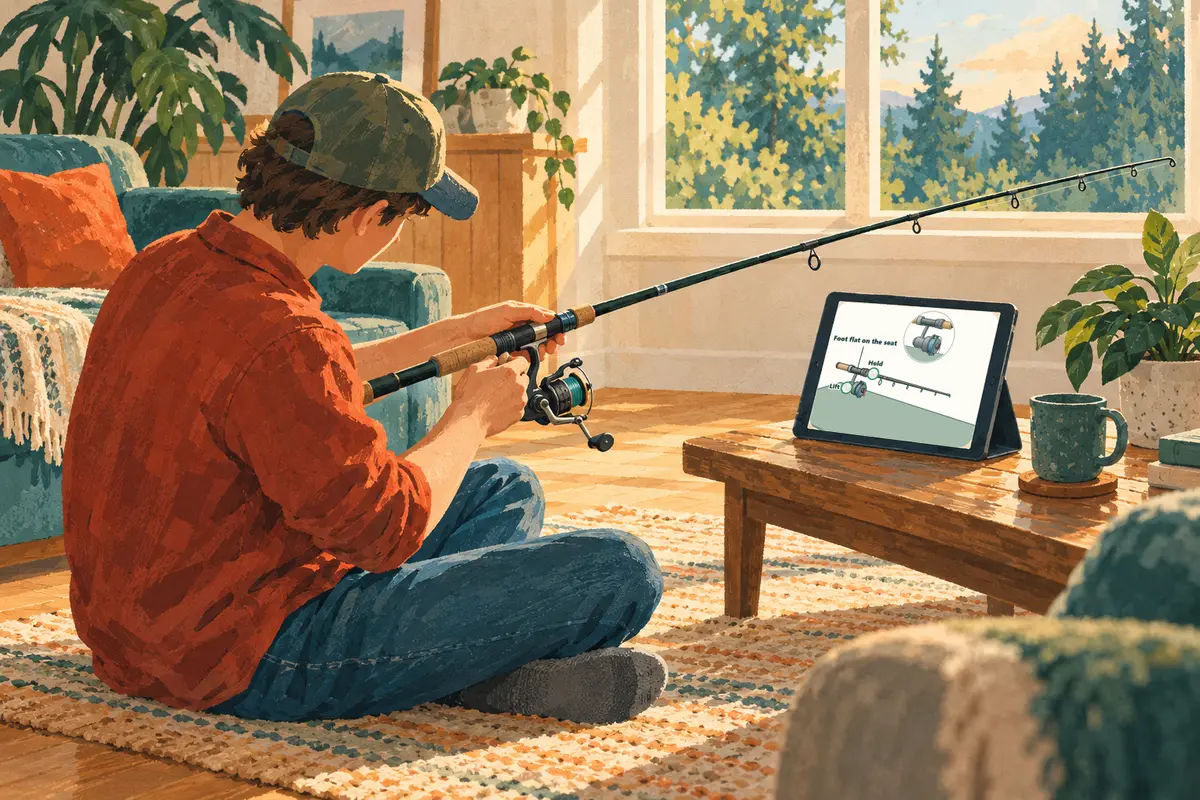
For a rod-and-reel lesson, check that the demonstration uses your type of reel, spinning or push-button spincast. Find each control on your own reel before copying the steps.
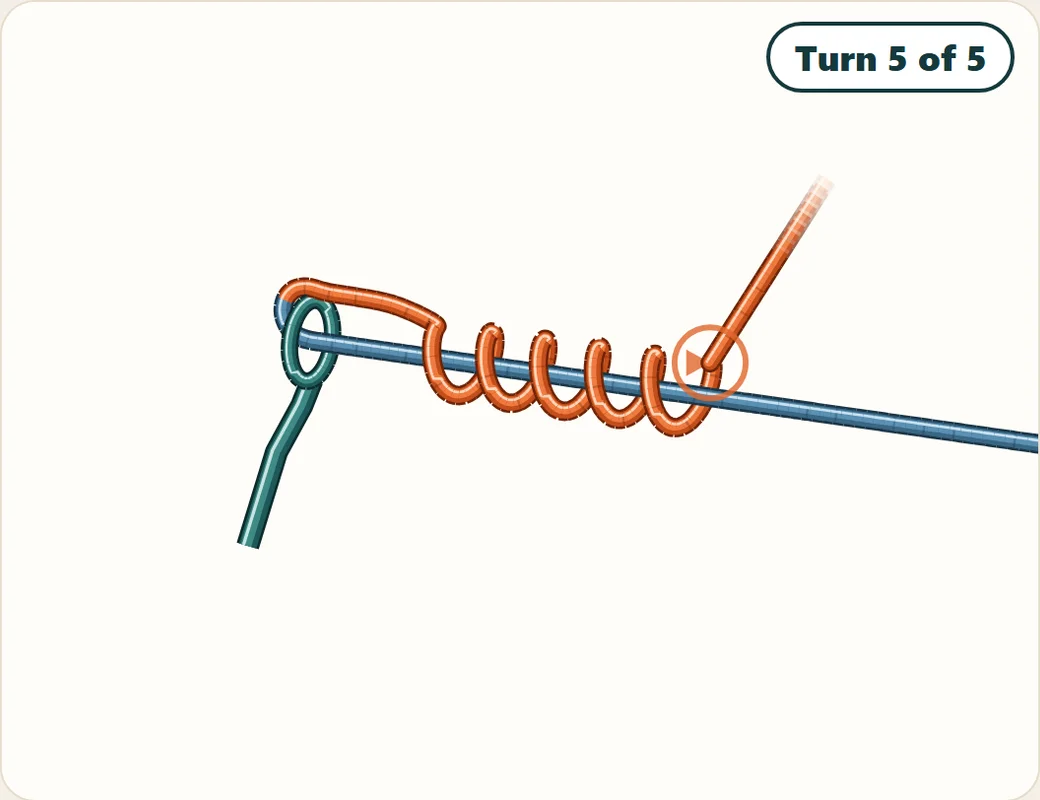
For a knot lesson, look for a close view that lets you follow both ends of the line. Pause where the ends cross or pass through a loop. Our learn fishing guide gives the basic knot and casting steps.
For casting, use a hookless practice plug, a weight made for casting practice, in an open area away from people. Look behind you and overhead before each cast. Fishing authorities recommend dry-land practice before fishing.
The app's improved clinch knot lesson includes an animation and optional practice on thick cord first, while its casting practice uses a hookless plug. Most lessons have a 3D animation you can turn with your finger, slow down and replay.
If a movement keeps failing after you replay it, ask an experienced angler to watch just that movement. For a full practice method, see can you teach yourself to fish.
Learn the rest beside real water
Lessons can explain what to notice, but you still have to observe conditions at the place you fish.

A bobber (float) shows movement when a fish takes bait, but water movement affects it too. A video can introduce that difference. Learning what your float does in the waves needs time beside real water. River current and contact with the bottom also give you things to observe that a screen cannot physically reproduce.
For sea fishing, choose instruction that covers waves, tides, rip currents, slippery rocks and safe access. Before going, use our first-time fishing guide for coastal safety planning, including when to stay away or leave.
The app stores lessons on the device for offline learning, so you can review its rod setup lesson before using your gear.
Put the screen away while casting or handling a fish. A saved lesson is a reference, not a current report of whether a place is safe.
Turn the course into a practice plan
Use each session to connect a lesson with something you can observe or do.
The following sequence is a suggested learning plan, not a timetable or a promise of a catch. Repeat a stage when needed. While you learn, use the same equipment and fishing method the course uses.
| Stage | Online lesson | Practical follow-through |
|---|---|---|
| Choose your starting point | Water, equipment and safety | Select one suitable local setup |
| Work away from water | Reel controls, knot and casting | Tie the knot and use a hookless plug |
| Prepare for the trip | Local rules, bites and fish handling | Check rules and prepare release tools |
| Learn beside the water | The setup you practiced | Note what worked and what confused you |
| Review afterwards | The specific step that caused trouble | Repeat it before adding another method |
Learn fish care before fishing, and rinse salt off your gear after sea fishing. For the handling and cleaning steps, see learn fishing.
Record a specific question for your next lesson: "I could not tell whether my knot was tight enough" is something you can revisit. Finishing the course ends the lessons, but you keep learning each time you fish.
Avoid these mistakes when choosing online instruction
These mistakes are about choosing and using a course, so you can spot a poor fit before you spend time or money.
Choosing by catches alone. A photo of a large fish does not show how clearly someone teaches a beginner. Preview the explanation of a simple task, such as setting up the reel.
Skipping the stated equipment or experience requirements. Make sure you can follow the first practical lesson with the equipment you have or plan to use. Ask about any missing basics before paying.
Treating a quiz as proof of a physical skill. Answering a casting question and making a controlled cast are different tasks. Include practice with your gear.
Accepting general rules as local permission. An old lesson or a completion certificate does not tell you whether you may fish at a particular place today. Check the current official rules.
Leaving fish care until the final lesson you watch. Read it before the first trip, even if you have not finished the course. Preparing to release a fish is part of learning to fish responsibly.
Frequently asked questions
How can I tell whether a fishing course starts at my level?
Read the lesson list and preview the equipment setup. A complete beginner should get explanations of the reel controls, safety and basic terms before advanced techniques. If you cannot follow the opening demonstration, ask which skills or equipment it assumes before enrolling.
How do I check whether free course access is only a sample?
Read the access terms before enrolling. Check whether every lesson is included, whether free access ends after a set period and whether enrollment starts a subscription. IGFA's Intro to Fishing course is free. For other courses, do not assume that free enrollment includes the whole lesson library.
Can adults take IGFA's Intro to Fishing course?
Yes. Although the course is designed for young people and beginners, IGFA says anyone can learn from it. Its curriculum includes both freshwater and saltwater material. Adults can use it as an introduction, then check local rules and practice the skills themselves.
How do I check whether a course covers saltwater fishing?
Look beyond the course title. Read the lesson list for saltwater equipment, bait, fish identification and coastal safety. IGFA's course includes saltwater identification and bait lessons. For any course, check which setting it covers, such as shore or boat, and use your local fishing authority for current saltwater rules.
Do I need fishing equipment before starting online lessons?
You can read or watch introductory lessons first. For practical lessons, you need the equipment being demonstrated or a suitable equivalent. Check the lesson list before buying anything. Use a hookless practice plug for casting practice away from the water.
Does an online fishing certificate replace a fishing license?
Do not assume it does. A course certificate records completion of that course. Check your local fishing authority for licenses and exemptions. Rules differ by country and region, and saltwater fishing may have separate requirements.
Should I finish an online course before practicing?
No. Follow the course's order, but pause to practice each task with your own equipment. Use a hookless plug for casting practice away from water. Read safety, local-rule guidance and fish care before the first trip, even if other lessons remain.
Sources
- International Game Fish Association: Intro to Fishing
- Ontario Ministry of Natural Resources: Learn to Fish
- Ontario Ministry of Natural Resources: Learn to Fish guide
- New York State Department of Environmental Conservation: Freshwater fishing basics for beginners
- Fisheries and Oceans Canada: Learn about and apply for a recreational fishing licence
- NOAA Fisheries: Catch and release fishing best practices
- Surf Life Saving NSW: Rock fishing
- Texas Parks and Wildlife Department: Fishing gear maintenance and repair
- Texas Parks and Wildlife Department: Tackle Loaner Program
- Ontario Ministry of Natural Resources: Free family fishing